Piloting Agentic Software Development: Measure Before You Scale
How to set up an agentic software development pilot: a real use case, your own baseline and controls in place from day one.
Date
Author
Reading time
Tags

AI delivers its first big savings in software development and IT. For any leadership team, that turns agentic software development into an investment decision: will it make our IT faster and cheaper? Licenses for every team, a round of training and a usage policy will bring AI agents into the company. They will not give you a number to base that investment on. For that, you need an agentic software development pilot that measures results against your own figures.
In our whitepaper “Die IT Dark Factory” (available in German), we describe how such a pilot works. A small team takes on a real use case for a fixed period, and the results are measured against the way the company has built software so far. We call this setup an “agentic cell.”
A pilot is a success when it puts hard numbers on one question: how do lead time, effort and functional quality change for a real use case, compared with the company’s current development process?
What a Pilot Needs to Prove
A pilot no longer has to prove that an AI agent can write and test code in hours. The real question is whether working software also reaches production faster and at lower cost. Integration, business validation, operations and accountability still take considerable work, even when an agent writes the code. AI makes code cheaper to produce. But that does not automatically make the outcome cheaper.
That gives the pilot three jobs. First, it shows where agentic development pays off in speed and cost, and where it does not. Second, it lays down the rule set all teams will eventually work by, with policies, regulatory requirements and architecture decisions turned into verifiable rules at fixed checkpoints. Third, it builds know-how that stays in the company.
A no-go is a perfectly valid outcome. If agents do not speed up a use case, leadership finds out before investing at scale.
Choosing the Right Use Case
How reliable these answers are depends first and foremost on the use case. It should be real and clearly scoped, with business logic that is easy to follow. And the company should pick it itself, because only then will the results carry over to its own development work.
Knowing what to leave out matters just as much. Three areas have no place in a pilot:
- changes to core systems without an audit trail
- production data migrations
- safety-critical control systems
In all three, mistakes are hard to trace or impossible to undo. A code change can be rolled back with a revert. Changed data and business transactions that have already been triggered offer no such way back, so they call for stricter checks and a dry run. A team that is still gaining its first experience with agents should not start with risks like these.
Measuring Against Your Own Baseline
Once the use case is chosen, the pilot needs a yardstick. It uses the company’s existing development work as its baseline and measures three things against it: lead time, effort in staff time and tokens, and functional quality. The baseline is set right at the start, along with the go/no-go criteria.
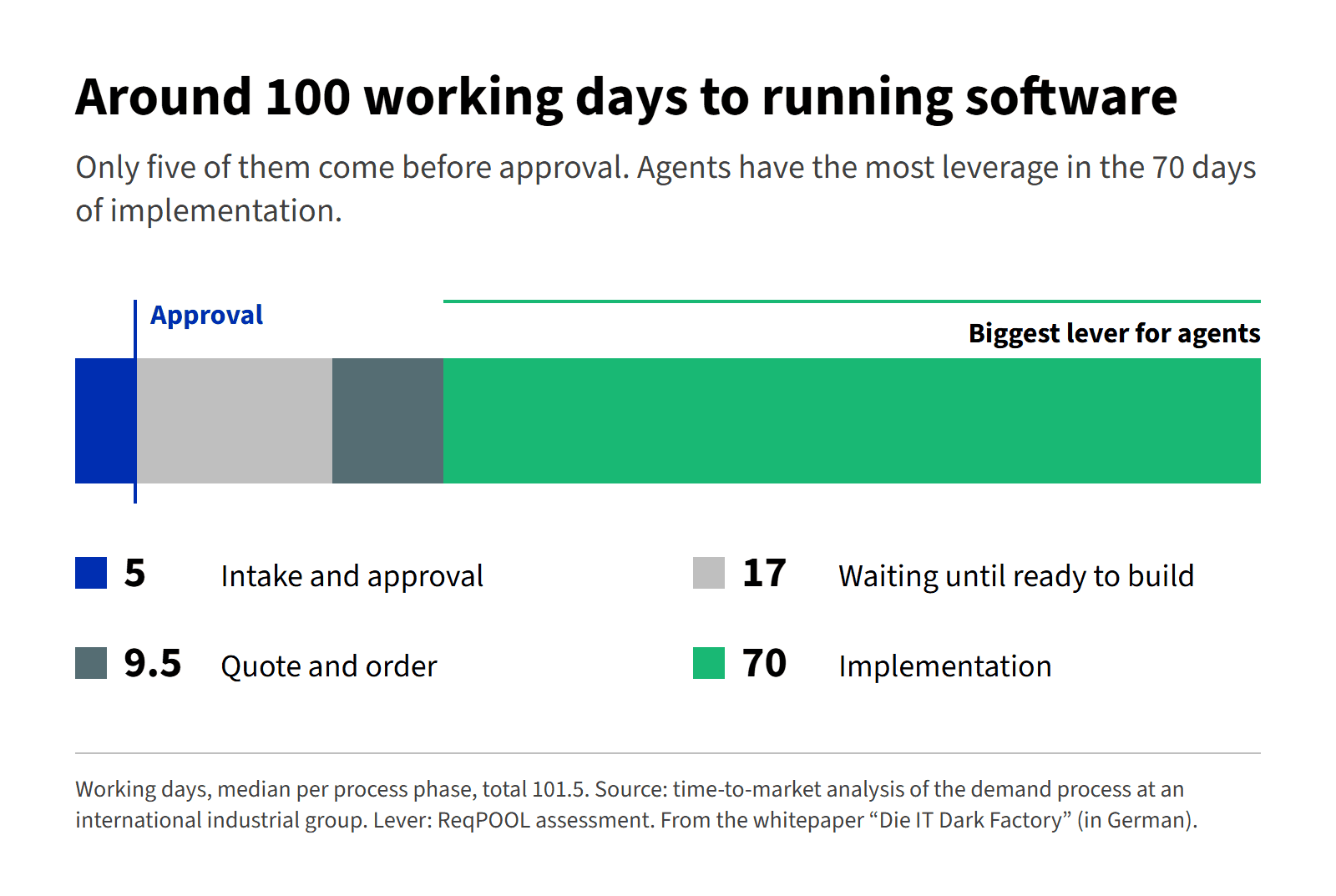
A time-to-market analysis from an international industrial group shows how much time is at stake. At this company, it takes around 100 working days for a logged requirement to turn into running software. Five of those days come before approval, and 70 go into implementation, which is where agents have the most impact. How much time they actually save depends on the type of change. And that can be measured rather than estimated.
Effort does not simply vanish, though. It shifts to specification, the rule set and verification. Only a comparison with the baseline shows whether the total ends up lower.
That is why the measurement has to cover the entire path into production. A reporting project from our own operations illustrates the gap. In a single day, it produced 15 tables, 8 pages and 80 visuals. Getting the target system to open the report took four attempts, and all four errors were structural, not content-related. Confirming that the report was running in production took 23 days. Had we measured only the generation step, we would have recorded one day and missed 23.
Setting Controls Before Day One
Besides a yardstick, a pilot needs clear limits, and they must be in place before the team works with its first agent. We have seen in our own company what happens without them:
- A production application ran on a laptop with a local database and a local language model. There was no sign-in through corporate accounts, no monitoring and no key management.
- Applications bypassed the central access point and connected straight to core systems, without showing up in any architecture overview.
- A cost analysis was missing its largest line item. The total looked plausible, and nobody questioned it.
An agent treats anything that is not technically blocked as allowed. The same logic works in reverse: if a rule is written into the agent’s instructions, the agent follows it. In our own work, when those instructions made an MCP server mandatory, the agent built one in 9 out of 11 cases. Without that requirement, the score was 0 out of 4.
For the pilot, this means the rules have to be set before work begins.
| Question | Set before the pilot starts |
|---|---|
| When is a result done? | Quality gates, approval criteria and a definition of done |
| How much can the agent spend? | A token budget allocated per project |
| Where are the boundaries? | Guardrails |
| Who decides when goals conflict? | People, via defined escalation paths |
| When do we continue, and when do we stop? | Go/no-go criteria |
| Who signs off and deploys to production? | The company, which also remains liable |
How the Five Months Unfold
With the use case, baseline and rules in place, the real work begins. It takes about five months. The team is trained first and then coached in its day-to-day work, while governance and process safeguards run in parallel. A review takes place at the halfway mark. At the end, the results are assessed against the baseline, and leadership receives a decision memo on rolling the approach out to more teams.
The whitepaper covers which roles the team needs, what investment is involved and how the phases fit together month by month.
The Outcome: A Complete End-to-End Case
The pilot delivers at least one complete case that covers the full path, from the initial business need through specification, rule checks and delivery to a working result in production. For that case, lead time, effort and functional quality are measured and compared with the baseline. The pilot also leaves the company with a tested rule set and a blueprint for its future development process.
With that evidence, leadership no longer has to guess whether agentic software development pays off for the company. The decision to expand rests on the company’s own numbers, and the pilot also shows where the money should go next.

“Development capacity is no longer the bottleneck. What is in short supply is the ability to write precise requirements, make rules machine-readable and prove results. That is where the budget belongs.”
Peter Schnitzhofer
Managing Partner, ReqPOOL
As the approach scales, the development process itself changes. Our overview of the agentic software development lifecycle describes where this leads, and our article on ten decisions in the agentic lifecycle covers the questions to settle along the way.

Peter Schnitzhofer
Geschäftsführer, Managing Partner Industrie und Mitbegründer
More about PeterMore articles




Get in touch
Arrange a no-obligation initial conversation with our contact person.
Christian Buchegger
Chief Sales Officer & Authorised Signatory