Publications & whitepapers
Scientific papers, whitepapers and infographics by ReqPOOL. Publisher links are freely accessible; register per publication to download the PDF – and receive future publications directly.
Whitepapers & infographics
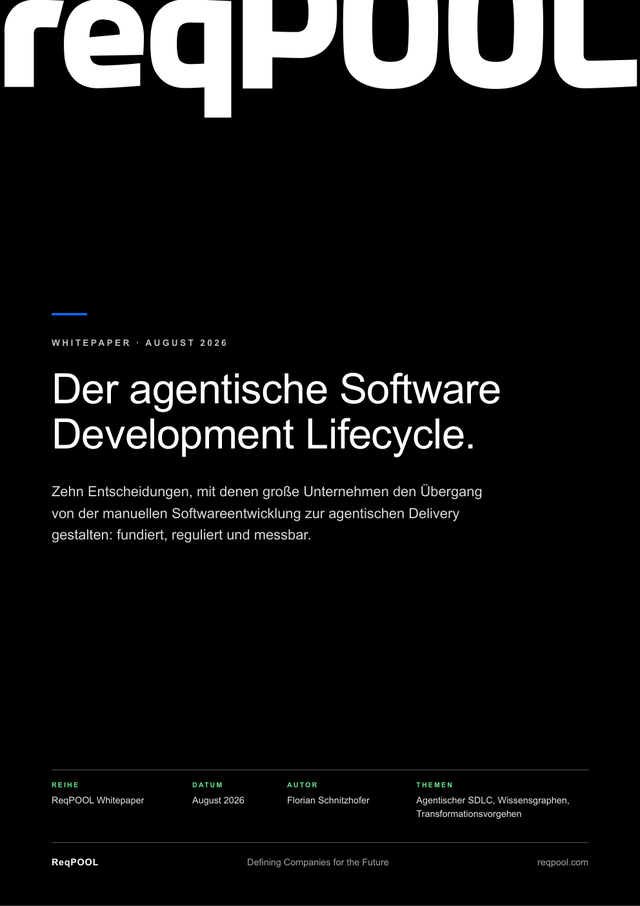
Der agentische Software Development Lifecycle
Zehn Entscheidungen, mit denen große Unternehmen den Übergang von der manuellen Softwareentwicklung zur agentischen Delivery gestalten: fundiert, reguliert und messbar.
Agentic AI does not change individual development steps but the operating model of software development itself: coordinated agents carry out the executing work across all phases while humans own intent, quality and approvals. The whitepaper sets out ten decisions on three levels – foundation, operating model, scaling – from “Own the Spec, not the Code” and the organisation's knowledge graph to verification, governance and evidence-based steering. A maturity model from L0 to L5 makes the path measurable; the tipping point lies between L3 and L4, where licences and training are no longer enough and organisation, quality assurance and governance have to carry the change. Four phases – diagnosis, target picture, piloting, scaling – form an 18-to-36-month programme in large organisations, with the first robust efficiency evidence emerging after 90 days of pilot operation.
Florian Schnitzhofer
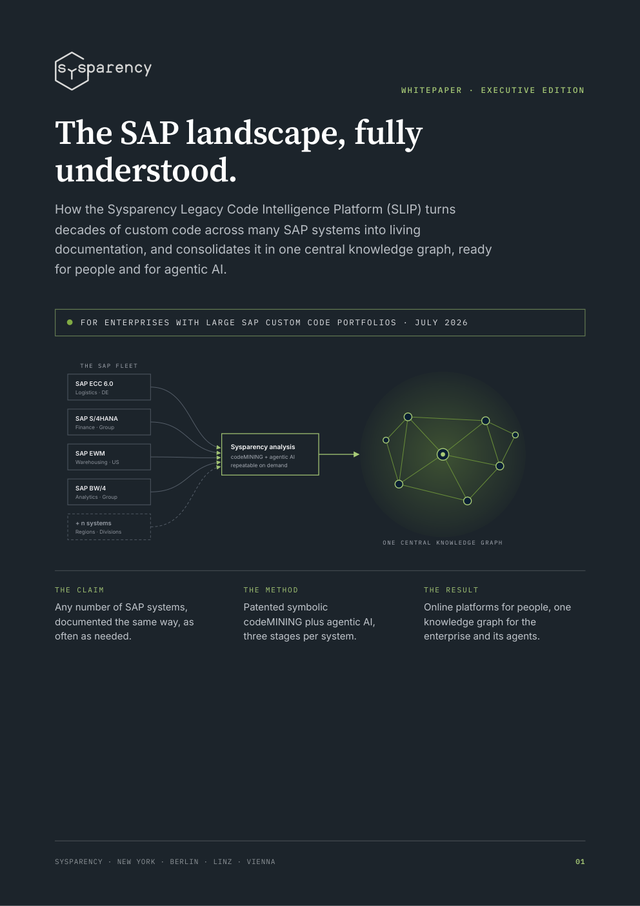
The SAP landscape, fully understood
How the Sysparency Legacy Code Intelligence Platform (SLIP) turns decades of custom code across many SAP systems into living documentation, and consolidates it in one central knowledge graph, ready for people and for agentic AI.
Every large SAP landscape is two systems: the documented SAP standard and the custom code built on top of it over twenty or thirty years, which carries the differentiation but whose documentation is outdated or lives in the heads of retiring experts. The Sysparency Legacy Code Intelligence Platform (SLIP) lets the corporation itself document every SAP system in three stages – patented symbolic codeMINING establishes the facts, agentic AI explains every artifact in business and technical language, and the results are consolidated in one central, source-cited knowledge graph – repeatable on demand at fleet scale. Teams browse and query the entire landscape through the Custom Code Intelligence Platform and the Sysparency Assistant, while the same graph, connected via MCP, grounds agentic AI systems in verified facts about the systems. As-is analyses are compressed from months to days, transformations such as S/4HANA scoping are planned on evidence instead of estimates, and management attention returns to the core value chain.
Sysparency
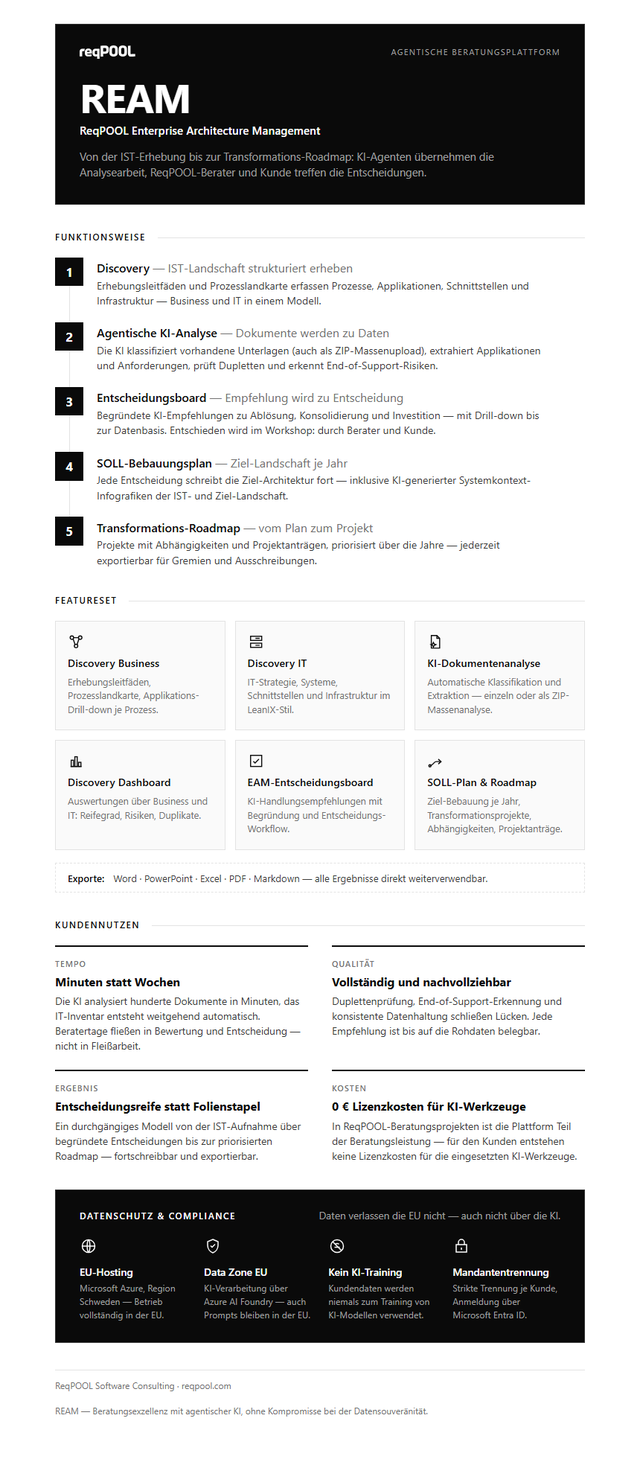
REAM – ReqPOOL Enterprise Architecture Management
Agentische Beratungsplattform: von der IST-Erhebung bis zur Transformations-Roadmap
The infographic shows on a single page how REAM, ReqPOOL's agentic EAM consulting platform, digitally supports the entire consulting process: discovery of business and IT, agentic AI analysis of existing documents, an EAM decision board with substantiated recommendations, a target landscape per year and a transformation roadmap with project proposals. AI agents take over the analysis work while ReqPOOL consultants and the client take the decisions – every recommendation can be traced down to the raw data. The client benefits: minutes instead of weeks for document analysis, complete and consistent data, decision-ready results instead of slide decks and no licence costs for the AI tools used; hosting and AI processing stay entirely within the EU. The infographic is available in a German (download) and an English version.
ReqPOOL
Scientific publications
Digital Twins of Legislation for Explainable Automated Decision-Making in Administrative Law
Florian Schnitzhofer, Anastasija Nikiforova, Christoph G. Schütz
AI & Open Government Workshop (AIOG) @ ICAIL 2026 – 21st International Conference on Artificial Intelligence and Law, Singapore · EN
Show abstract ↓Hide abstract ↑
Automated decision-making (ADM) in public administration must meet strict requirements of legality, transparency, and explainability. One potentially relevant but still underexplored route to achieve this is the Digital Twins of legislation, which can help synchronize legal texts, semantics, and executable decision logic. This paper investigates how such legislative digital twins can support explainable, rule-of-law–compliant ADM in administrative law. Based on grounded, inductive analysis of senior expert interviews, we identify four feasibility conditions for trustworthy ADM: (1) selective automation of deterministic sub-decisions, (2) semantic standardization and ontological alignment, (3) computable legal structures that link natural-language norms to machine-interpretable logic, and (4) drafting and governance adaptations enabling synchronized updates. Building on this, we derive design principles and a four-layer Digital Twin of Administrative Law (DTAL) architecture comprising statutory text, ontology, configuration, executable logic and illustrate its operation through a tourism contribution levy use case. This study contributes empirically grounded design principles, and a mid-range process theory explaining when and how administrative norms can be operationalized through digital twins. We propose an architectural approach that enables deterministic sub-decisions to be automated while preserving human oversight, legal traceability, and institutional legitimacy.
Reducing Administrative Burden by Automating the Translation of Administrative Law into Digital Twins of Legislation
Florian Schnitzhofer, Anastasija Nikiforova, Christoph G. Schuetz
JURISIN 2026 – International Workshop on Juris-informatics (JSAI-isAI 2026); post-proceedings in: New Frontiers in Artificial Intelligence, Lecture Notes in Computer Science, Springer Nature Singapore · EN
Original publication ↗ · doi:10.1007/978-981-92-1527-0
Show abstract ↓Hide abstract ↑
Administrative laws are traditionally published only in natural language, forcing each agency and business to manually encode identical rules into software, which is a redundant process that invites inconsistency and high maintenance costs. This paper introduces Digital Twins of Administrative Law (DTAL) as a centrally maintained, machine executable representation of legislation that remains synchronized with the authoritative legal text and preserves explicit traceability links. We propose a semi-automated, human in the loop pipeline that assists experts in transforming statutory provisions into an executable and testable DTAL bundle. The approach is evaluated in a real world case study on the Upper Austrian Tourism Contribution Levy using five implementation scenarios and a ground truth test set. Our results show that the centrally published DTAL can reduce administrative burden by an order of magnitude (35× reduction) and avoids duplicate law-to-code translations, while improving traceability and correctness of legal computations. Our work bridges legal informatics, public administration, and AI system design, and suggests policy implications for more transparent and efficient digital governance.
Reducing Administrative Burden with Digital Twins of Legislation
Florian Schnitzhofer, Christoph G. Schütz
Chapter 5 in: The Self-Driving State (book manuscript, 2026) · EN
Show abstract ↓Hide abstract ↑
Public administrations increasingly explore automated decision-making, yet the normative content of legislation remains embedded in natural-language statutes rather than in machine-interpretable structures, so every agency, software vendor and business re-codes the same rules. This chapter introduces the Digital Twin of Legislation (DTL) – a synchronized, machine-executable representation of a defined set of legal provisions that is explicitly linked to the promulgated legal text and versioned alongside amendments – and operationalizes the vision of The Self-Driving State in five steps: it defines DTLs and derives design principles for rule-of-law-compatible automation, introduces a four-layer reference architecture linking legal text, semantics, parameters and executable logic, presents a semi-automated, human-in-the-loop pipeline for transforming statutes into DTL bundles, and evaluates the approach on the Upper Austrian tourism contribution case study, showing a reduction of collective implementation effort by approximately 35× under the study assumptions and full correctness on the expert-validated test set. Finally, it discusses governance implications for publishing, maintaining and certifying DTLs, emphasizing legal traceability and explainability as prerequisites for trust in AI-driven governance.
Enhancing Automated Decision-Making in Administrative Law Through Digital Twins of Legislation
A Grounded Theory Approach
Florian Schnitzhofer, Christoph G. Schuetz
JURIX 2025 – 38th International Conference on Legal Knowledge and Information Systems, Turin, Italy; in: Legal Knowledge and Information Systems (Frontiers in Artificial Intelligence and Applications), IOS Press · 436–438 pages · EN
Original publication ↗ · doi:10.3233/FAIA251630
Show abstract ↓Hide abstract ↑
Automated decision-making in administrative law holds the promise of considerable efficiency gains, enhanced consistency, and increased transparency. This extended abstract distills a qualitative study based on semi-structured expert interviews that adopts a grounded theory approach to investigate the preconditions, constraints, and opportunities for embedding the concept of Digital Twin of Administrative Law (DTAL) into legislative and administrative processes while safeguarding the Rule of Law.
Towards Translating Natural Language Normative Text into a Digital Twin of Administrative Law
Florian Schnitzhofer, Christoph G. Schuetz
NLL2FR 2025 – International Workshop on Translating Natural Legal Language into Formal Representations, in association with JURIX 2025, Turin, Italy (Proceedings ed. K. Satoh, G. Borges, H. Westermann, M. M. Zin) · 157–163 pages · EN
Show abstract ↓Hide abstract ↑
Automating public-sector decision-making promises efficiency gains in administration. This short paper proposes a research agenda for translating natural-language normative text into a Digital Twin of Administrative Law (DTAL), which we envision as a layered, executable representation of statutes that preserves traceability to the authoritative legal text while enabling accountable automation of decision-making in the public sector. To obtain a DTAL from normative text, a stepwise translation pipeline must be followed, which we demonstrated on the Upper Austrian Tourism Contribution Levy Act. The resulting DTAL yields deterministic and explainable outcomes. In this short paper, we outline open questions on standardizing legal ontologies, integrating LLMs as assistant tools, and embedding DTALs into public-sector engineering practices to realize transparent auditable automation of decision-making aligned with the rule of law.
Enhancing Automated Decision-Making in Administrative Law Through Digital Twins of Legislation: A Grounded Theory Approach
Florian Schnitzhofer, Christoph Schütz
JURIX 2025 – 38th International Conference on Legal Knowledge and Information Systems (full-length version; published as extended abstract in FAIA, IOS Press) · EN
Show abstract ↓Hide abstract ↑
Automated Decision-Making (ADM) in administrative law holds the promise of significant efficiency gains, enhanced consistency, and increased transparency. Yet, the inherent complexity of statutory drafting, semantic ambiguities, and evolving governance frameworks pose substantial challenges to its scalable implementation. This study adopts a Grounded Theory approach to investigate the preconditions, constraints, and opportunities for embedding Digital Twins of Administrative Law (DTAL) into legislative and administrative processes while safeguarding the Rule of Law. Drawing on semi-structured expert interviews with nine representatives from the European Parliament, academia, national parliament, ERP system vendors, and notarial practitioners, our findings identify four critical success factors for enabling ADM: (1) embracing only partial transformation, acknowledging that not all laws are automatable; (2) achieving semantic standardization and ontological alignment; (3) Transforming legislation into high-quality ADM-supporting structures; and (4) adapting legislative drafting processes and governance mechanisms to accommodate ADM. The results indicate that while partial automation is feasible, particularly in deterministic domains such as taxation and subsidies, most legal frameworks require hybrid models that preserve human judgment and interpretative flexibility.
Towards a Scalable Architecture for Legal Ontologies Integrated into Digital Twins of Administrative Law
Florian Schnitzhofer, Christoph G. Schuetz
Developers Workshop @ SEMANTiCS 2025 – 21st International Conference on Semantic Systems, Vienna, Austria; CEUR Workshop Proceedings Vol. 4064 · EN
Show abstract ↓Hide abstract ↑
Administrative-law provisions are still published almost exclusively in natural language, forcing every stakeholder to translate identical rules into bespoke code bases—a practice that invites inconsistency, hampers transparency, and inflates maintenance costs. Recent work on Digital Twins for Administrative Law (DTAL) suggests that legislation be issued together with machine-readable ontologies and executable logic, yet guidance on how to architect such systems remains scarce. In this work we propose a layered reference architecture that separates (i) the natural-language statute, (ii) a core ontology expressed in OWL, (iii) a configuration layer for mutable policy parameters, and (iv) an executable-rule layer exposed through a RESTful and MCP façade. Grounded in design science research, we implemented a proof-of-concept twin of the Upper-Austrian tourism-levy statute and qualitatively evaluate the twin with legal, software, and public-administration experts. Early results suggest that ontology-driven twins can reduce duplicate implementations, streamline updates, and enhance legal certainty, thereby strengthening the Rule of Law in automated decision-making.
Integrating Legal Ontologies and Digital Twin Technology: Enhancing Rule-of-Law-Compliant Automated Decision-Making in Administrative Law
Florian Schnitzhofer
PhD Symposium @ ESWC 2025 – 22nd Extended Semantic Web Conference, Portorož, Slovenia · EN
Show abstract ↓Hide abstract ↑
Administrative laws are traditionally published in natural language, necessitating multiple, redundant software implementations that lead to inefficiencies and inconsistencies. In response, this early-stage Ph.D. research introduces a framework for co-publishing ontologies alongside statutory text, forming a digital twin for administrative law (DTAL). Using an Austrian tourism levy as a case study, this research investigates how simultaneously publishing ontology-based and legal prose representations can minimize redundant software development efforts, reduces errors, and support rule-of-law-compliant automated decision-making. Preliminary prototypes indicate measurable reductions in development effort and update latency, underscoring the approach's practical viability.
Integrating Legal Ontologies and Digital Twin Technology
Enhancing Rule-of-Law-Compliant Automated Decision-Making in Administrative Law
Florian Schnitzhofer
PhD Symposium @ ESWC 2025 – 22nd Extended Semantic Web Conference, Portorož, Slovenia (poster) · EN
Show abstract ↓Hide abstract ↑
Administrative laws are traditionally published in natural language, necessitating multiple, redundant software implementations that lead to inefficiencies and inconsistencies. In response, this early stage Ph.D. research introduces a framework for co-publishing ontologies alongside statutory text, forming a digital twin for administrative law (DTAL). Using an Austrian tourism levy as a case study, this research investigates how simultaneously publishing ontology-based and legal prose representations can minimize redundant software development efforts, reduces errors, and support rule-of-law-compliant automated decision making. Preliminary prototypes indicate measurable reductions in development effort and update latency, underscoring the approach's practical viability. The poster condenses problem context, research question and methodology, state of the art and the four-layer DTAL architecture (text, ontology, model, logic) onto a single page.
Applying Digital Twin Principles on Administrative Law
Using Smart Contracts and Legal Ontologies for Automated Decision-Making
Florian Schnitzhofer
ACM CS&Law 2025 – Symposium on Computer Science and Law (presentation slides, March 2025) · EN
Show abstract ↓Hide abstract ↑
Presentation deck of the doctoral research on Digital Twins for Administrative Law (DTAL). Laws are published exclusively in natural language, so every public and private organisation has to interpret them manually and re-implement identical rules in its own software – an inefficient, error-prone process that frequent amendments make worse and that puts the rule-of-law compliance of automated decision-making at risk. The talk asks which representation of administrative law enables automated decision-making under the rule of law while preserving the necessary interpretive flexibility, and proposes combining the structure of smart contracts, domain-specific legal ontologies and digital-twin principles from engineering into a four-layer architecture of text, ontology, model and logic that is implemented once and consumed by all systems via API. It outlines the design-science research plan with three sub-questions (semantic alignment, abstraction and complex dependencies, ADM with laws) and reports on the design cycles to date: the book “Der selbstfahrende Staat”, a prototype digital twin for parts of the Austrian income tax, a Prolog-based twin of the Upper Austrian landscape levy and the ongoing tourism-levy use case.
Towards the Design of Digital Twins for Tax Law
Using Smart Contracts and Legal Ontologies for Automated Decision-Making
Florian Schnitzhofer
IRIS 2025 – 28. Internationales Rechtsinformatik Symposion, Salzburg, Austria · EN
Show abstract ↓Hide abstract ↑
This paper presents proposed research on the design of a framework for automating decision-making in tax software systems through the development of digital twins of tax laws, using the Austrian Income Tax Act as an example. These digital counterparts of the legal texts formulated in natural language are structured into four layers, inspired by the structured approach of smart contracts used in automated legal contract systems: (1) the legal text, (2) a domain-specific tax ontology, (3) a model layer for data configurations, and (4) a logic layer where the tax law logic is implemented in a formal language. By formalizing these layers, we intend to create a comprehensive, machine-interpretable representation of (parts of) existing tax laws. Future work will further investigate which parts of law texts can be formalized in digital twins, which decisions can be automated, and where human inputs will continue to be required.
Books
Das selbstfahrende Unternehmen
Ein Denkmodell für Organisationen der Zukunft
Florian Schnitzhofer · Springer
The Self-Driving Company
A Conceptual Model for Organizations of the Future
Florian Schnitzhofer · Springer
Der selbstfahrende Staat
Ein Denkmodell für das Zusammenleben im Staat der Zukunft
Florian Schnitzhofer, Patrick Pils, Philipp Seper-Ambros · Springer Gabler
The Self-Driving State
AI-Driven Governance and the Transformation of Public Administration
Florian Schnitzhofer, Patrick Pils, Philipp Seper-Ambros · Springer
Das resiliente Unternehmen
Die Krisen der Zukunft erfolgreich meistern
Achim Röhe · Springer
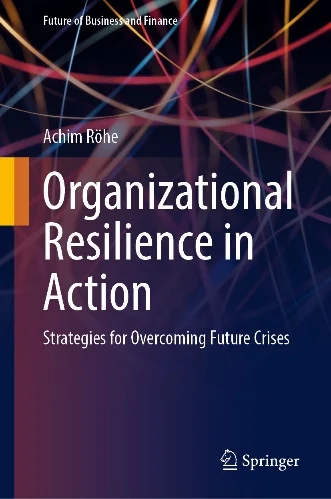
Organizational Resilience in Action
Strategies for Overcoming Future Crises
Achim Röhe · Springer

Questions about a publication?
Research cooperation, lectures or a conversation about applying the results in your organisation.
Florian Schnitzhofer
Founder & CEO ReqPOOL · Researcher JKU Linz